
The work begins with the question, not the service.
KSP works with institutions across research, policy dialogue, training and technical assistance. Which of those an engagement uses is decided by the problem in front of it.
The organisation assists governments, public and private institutions and international development partners in developing, implementing and evaluating policies and programmes that are robust, contextually relevant and sustainable — and it carries that work through to implementation rather than stopping at recommendations.
Islamabad · Working with government, public and private institutions, and international development partners · Four service areas, one engagement at a time
Four kinds of work.
One engagement may draw on more than one of them. Research leads into dialogue; dialogue into training or technical assistance. Start wherever your problem sounds closest.
Multi-disciplinary analysis and research
KSP anchors its analysis on three pillars, so that what a study finds can be acted on by the institution that commissioned it.
An institution needs to understand a problem, and its context, before deciding what to change.
Research designed for the context it is used in
Studies are rooted in the socio-economic, cultural and political realities of the regions they cover. Tailoring the design to the local context is what makes findings capable of informing interventions that are feasible on the ground.
Stakeholder engagement and multidisciplinary collaboration
A diverse array of partners is involved throughout the research process rather than consulted at the end. The analysis therefore carries a broad spectrum of knowledge and expertise, and produces more comprehensive solutions than a single discipline would reach.
Clear pathways to implementation
Recommendations are aligned with existing policy frameworks and written in accessible, actionable formats. Holding the three pillars together is what keeps the research academically rigorous and still usable in a development or policy setting.
- Study design and instruments
- Fieldwork in Pakistani contexts
- Findings written for the decision at hand
- Recommendations in accessible, actionable formats
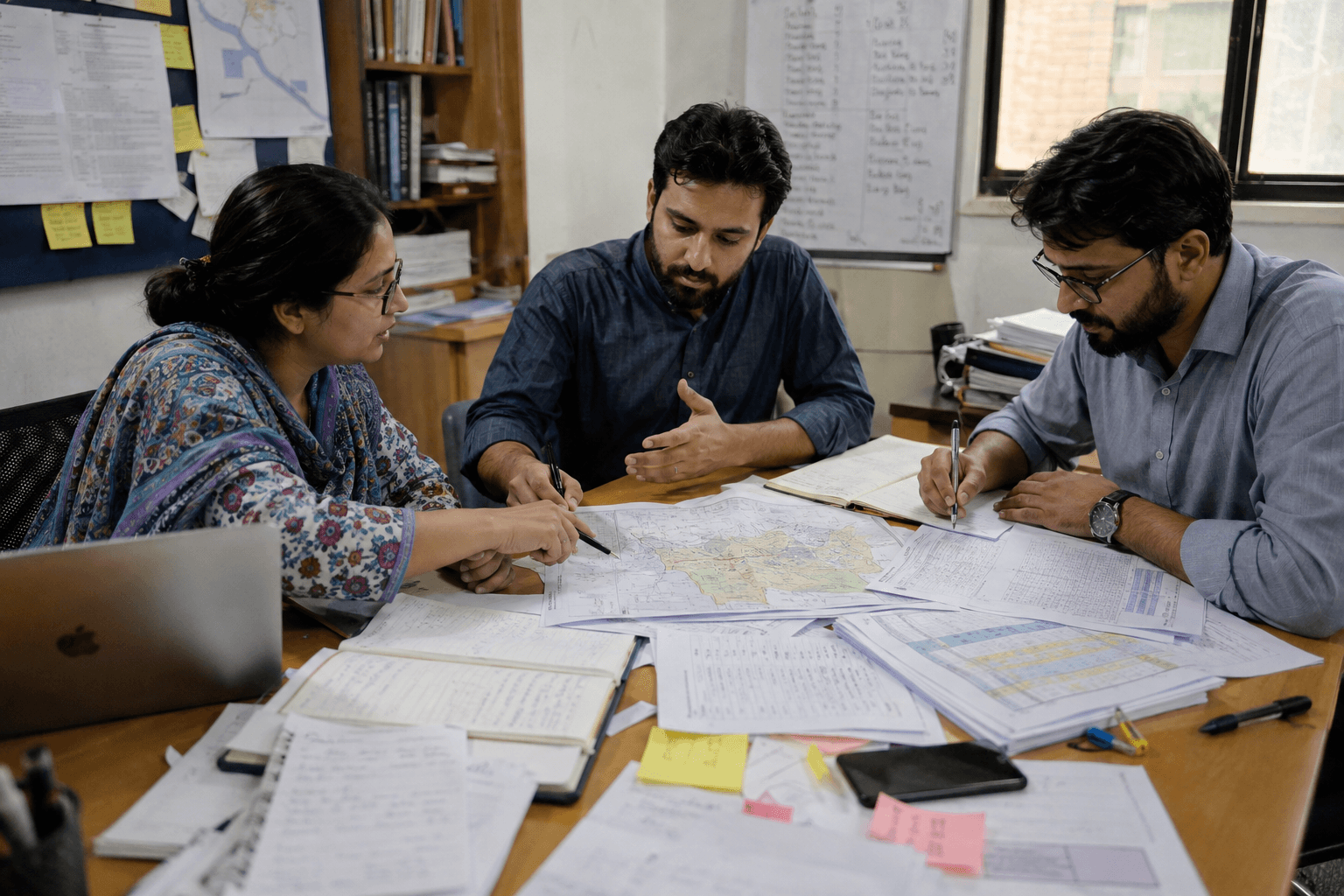

Policy dialogues
Dialogue is part of the evidence, not an event around it.
KSP hosts policy dialogues that bring together a range of policy experts, practitioners and market actors to discuss the key developmental challenges facing Pakistan. Convening is treated as a method: it surfaces what different actors already know, tests an idea against the people who would have to run it, and records what was agreed so it can inform a decision afterwards.
- Policy experts
- Practitioners
- Market actors
A challenge crosses institutions and has to be discussed by the people who work on it before anything is designed.
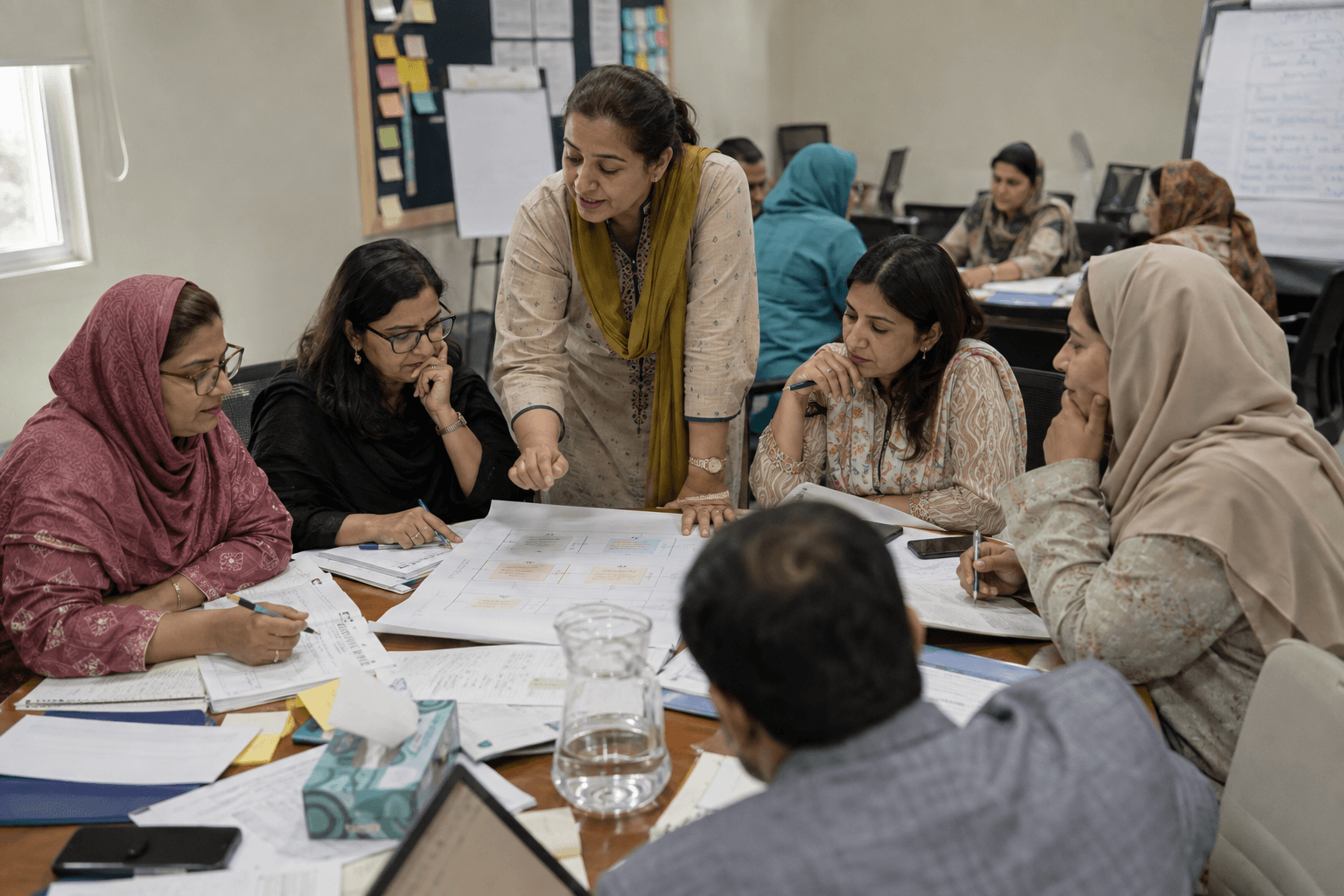
Training and capacity building
Capability that stays after the engagement ends — in the people, and in the institution around them.
The capability has to remain inside the institution once KSP is no longer in the room.
KSP works on capacity building and empowerment through a multi-faceted approach that strengthens both individuals and institutions, particularly in the education sector, with a focus on STEM and STEAM. Teachers are given the knowledge and pedagogical techniques to teach those subjects; schools are supported to develop the governance, resource management and decision-making structures that let them operate sustainably.
Alongside both sits sustainable resource mobilisation — helping schools and educators secure and manage the financial, technical and human resources needed to hold education outcomes over the long term.
| Domain | What it covers |
|---|---|
| Institutional strengthening |
|
| Skills development and training |
|
| STEM and STEAM focus |
|
| Sustainable resource mobilisation |
|
Source: KSP capacity building and empowerment framework, as set out in current KSP material. Presented here as a service description.
Technical consulting and assistance
Data-driven insights that offer actionable policy advice grounded in rigorous evidence and contextual understanding — worked out alongside the institution’s own team.
Recommendations are aligned with the specific challenges and realities of each client rather than lifted from a standard model.
An institution knows broadly what it needs to change and needs technical help to design, run and sustain it.
Contextual relevance
Consulting work is localised — rooted in the socio-economic, cultural and political realities of the region served, so that what is proposed is feasible where it has to operate.
Capacity building
Where necessary and applicable, institutions are equipped with the skills, tools and frameworks to implement and sustain the solution themselves.
Collaborative stakeholder engagement
Diverse perspectives are incorporated as the work is developed, so that policy and operational solutions are inclusive and achievable.
Sustainable outcomes
Systems are designed to be adaptable, so they remain effective well beyond the initial implementation phase.
What the engagement does, and what it leaves behind
Research and analysis
Tailored insights delivered to the institution
Stakeholder engagement
Advice that is inclusive and achievable
Capacity building
Sustainable outcomes and long-term impact
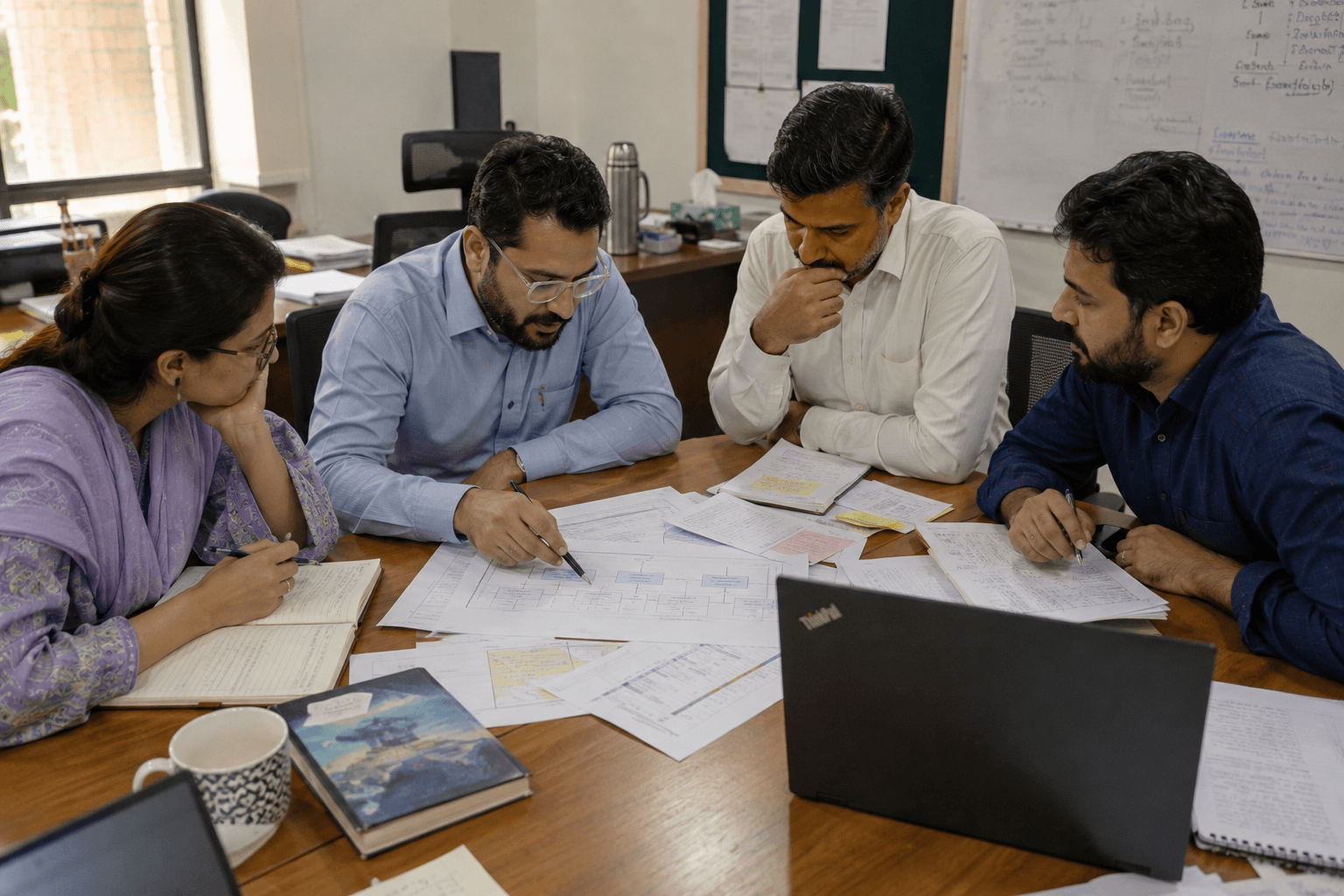
How KSP works.
KSP’s methodology is anchored in rigorous research, stakeholder engagement and actionable insights. Five commitments hold across every engagement, whichever services it draws on.
Listed without numbers. These are disciplines applied throughout an engagement, not stages in a sequence.
Evidence-based analysis
Data-driven research is used to inform policy decisions — the analysis comes before the recommendation, and is stated with it.
Stakeholder collaboration
All relevant parties are engaged so that policy development is inclusive and participatory rather than produced at a distance from the people it affects.
Contextual relevance
Policies are tailored to align with the socio-economic and cultural landscapes they will operate in.
Continuous evaluation
Outcomes are monitored and assessed while the work runs, to support ongoing improvement rather than a verdict at the end.
Implementation support
Guidance and tools are provided for effective policy execution — the point at which most advice stops and KSP's engagements usually continue.
Policy consultancy in practice
KSP provides policy consultancy services for informed decision-making and effective governance, assisting governments, organisations and institutions in developing, implementing and evaluating policies that are robust, contextually relevant and sustainable. The work below is organised as three areas of policy activity.
Policy analysis
Establishing what current policy actually does before anything is proposed.
Situation assessment
Evaluating existing policies to identify strengths, weaknesses and gaps.
Impact studies
Analysing the potential effects of policy options on various stakeholders.
Regulatory review
Assessing compliance with legal and regulatory frameworks.
Policy development
Turning an agreed direction into a document an institution can act on.
Strategic planning
Crafting policy frameworks aligned with organisational goals and societal needs.
Stakeholder consultation
Facilitating dialogue to incorporate diverse perspectives and expertise.
Drafting and documentation
Developing clear, actionable policy documents and guidelines.
Policy evaluation
Knowing whether the policy is doing what it was written to do.
Monitoring and evaluation (M&E)
Establishing systems to track policy performance and outcomes.
Performance metrics
Defining key performance indicators and benchmarks for success.
Feedback mechanisms
Implementing systems for ongoing stakeholder input and policy refinement.
Content relationship requires confirmation — this policy consultancy material is carried over from the existing Knowledge Services page. How these three areas sit against the four service areas above has not been verified with KSP, so they are presented here as a deeper area of practice rather than as a fifth service.
Services in practice
These capabilities are not only offered to others. CORE Assessments and Central School International are built and operated by KSP on the same analysis, training and technical assistance described above — which is where the approach gets tested against the cost of running something every day.
Start with the problem.
Tell KSP what the institution is trying to understand, change or build. The right combination of research, dialogue, training and technical assistance can follow from there.