Institutions built from evidence.

KSP's work centres around a portfolio of projects that adhere to global standards of excellence while remaining responsive to local needs.

Two of those projects are institutions KSP leads itself — a school and an assessment platform — where the method has to hold every day, not only in a report.

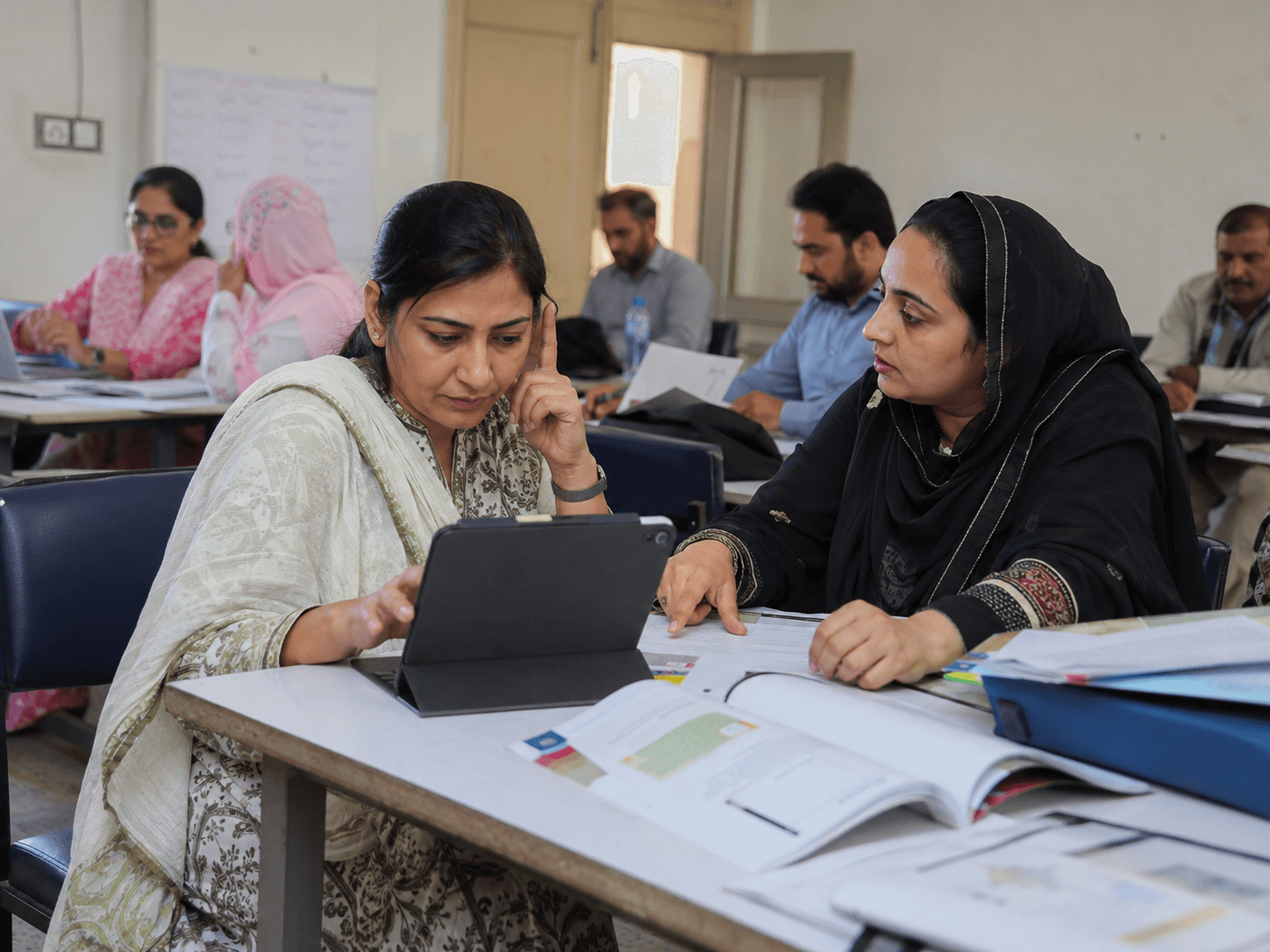
Two educators working through assessment material on a tablet and a printed workbook during a CORE Assessments session.

Central School International

An educational institution rooted in cultural values while embracing global excellence, operating at the forefront of research.

CSI was built by KSP as a working answer to the question the organisation studies elsewhere: what an education looks like when it is designed around the individual learner rather than the cohort. The school is run, not advised — which means the model has to hold against a timetable, a staff room, a class size and a building.

Education at CSI is centred around four commitments, and each of them shows up in how the school is organised rather than only in how it is described.

School education · Built and operated by KSP · Operating

Model: personalised, project-based, technology-enabled.

Personalised learning

Tailored to the unique strengths and gifts of each child.

21st-century skills

Focused on developing the skills essential for success in the modern world.

Rigorous academics

Centred around a challenging academic curriculum.

Technology-enabled

Enhanced by the latest technological advancements.

What CSI offers

Four provisions describe the school more precisely than any prospectus sentence: how the academic programme runs, what happens after the timetable, how large a class is, and what the campus is equipped for.

01

Project-based learning

CSI's academic programme utilises project-based learning to ensure that students learn in a manner which is interactive, evidence based and effective.

In practice this is the school's organising principle rather than an enrichment activity: subjects meet inside one problem, and the work students produce is the assessment.

02

Extended Learning Program

CSI's Extended Learning Program (ELP) is purpose built to cultivate 21st-century skills in its students.

It sits deliberately outside the academic timetable, so the skills the school claims to develop have somewhere to be practised rather than only assessed.

03

Small class sizes

CSI maintains a student–teacher ratio of 12:1 across its classes. It is the structural condition personalised learning depends on: the ratio is what makes tailoring to each child a timetable fact rather than an intention.

12:1

Student–teacher ratio, across all classes

Central School International, as stated on the CSI provision. Reporting year to be confirmed.

04

Custom-made sports programme

Facilities include swimming pools and rock-climbing walls to promote physical development.

Project-based learning

One problem connecting multiple disciplines — the academic programme as it is actually run.

Admissions, curriculum, campus and the full Extended Learning Program are set out on the school's own pages.

Explore Central School International

CORE Assessments

Technology-enabled assessment and training, positioned at the intersection of EdTech, assessments and training.

Through CORE Assessments, KSP introduces technology-enabled assessment solutions and training modules designed to comprehensively upskill and evaluate educators and learners alike. CORE aims to address the quality issues of human capital within the education sector through a commercially viable business model.

Where CSI is a place, CORE is an instrument: content, assessment protocols and a delivery architecture that can be applied wherever an education workforce needs measuring and developing.

Serves
Educators and learners
Delivers
Assessment solutions, training modules, a dedicated learner dashboard
Model
Commercially viable business model
KSP role
Built and operated by KSP
Status
Operating

Key features of CORE Assessments

CORE Assessments is designed to change how educational evaluation and training are delivered, by integrating technology with comprehensive content.

Expert instruction

CORE's instructors are industry leaders, bringing invaluable real-world insight and a passion for teaching to every lesson. Instruction is not generic training content bought in and relabelled: the people teaching a module are practitioners in the subject the module assesses.

Advanced learning management system

A state-of-the-art learning management system designed for optimal learning experiences. It carries course content, revision material and assessment protocols together, which is what allows a programme to be delivered consistently to cohorts in different places.

Formal certification

Participants earn recognised certificates that validate their skills and open up new career opportunities — the point at which professional development becomes something an educator can carry with them.

The CORE approach

Five commitments that hold at the same time. They describe how a CORE programme is designed, taught, measured and corrected.

Expert instruction

Lectures and knowledge products are created by experts with deep insight into the professional development process. With CORE Assessments, upskilling and capacity development are conducted under expert instruction and supervision rather than left to self-service material.

Based on evidence

At the heart of the approach is a reliance on data and evidence. Support is provided through mechanisms, processes and pedagogy which have been proved to work and work well — the same standard KSP applies to the research it publishes.

Consistent feedback

The most optimum way to learn is by incorporating feedback into the learning process. CORE has built-in self-assessment protocols and tools to help learners consistently gauge their performance and address lagging areas while there is still time to act on them.

Self-paced

All courses are designed to allow learners to study them at their own pace. Studies and self-assessment can be organised in a manner and order best suited to an individual learning journey and to the circumstances of working educators.

Focused guidance

Courses have built-in mechanisms to ensure that areas in need of attention are highlighted and brought to the learner's notice well in time. Guidance then hones in on the specific areas in which further assistance is required, so that learning is both effective and efficient.

Digital assessment and accessibility

CORE uses digital means to ensure that its expertly designed and delivered content is easily accessible for all users.

This is achieved through a dedicated dashboard where all content is presented in a consolidated manner. The dashboard is designed according to best practices and is user-specific: every user accesses course content, revision materials and assessment protocols tailored to their individual professional development needs.

This custom-made digital architecture is what allows CORE to deliver high-quality capacity development across the country.

Consolidated in one dashboard

  • Revision texts
  • Quizzes
  • Supplementary materials
  • Assessments and assessment protocols

Explore CORE Assessments

Capabilities behind the work

CSI and CORE are not separate ventures with their own methods. They are built and run on the capabilities KSP also brings into client engagements — analysis and research, technical consulting and assistance, and training and capacity building.

Multi-disciplinary analysis and research

KSP anchors its multi-disciplinary analysis on three foundational pillars to produce actionable and contextually relevant insights for the development sector.

Context-specific research

KSP prioritises contextual relevance and localisation, ensuring that all research is deeply rooted in the socio-economic, cultural and political realities of the regions it serves. By tailoring studies to local contexts, findings can inform interventions that are both feasible and impactful on the ground.

Stakeholder engagement and multidisciplinary collaboration

KSP emphasises stakeholder engagement and multidisciplinary collaboration by involving a diverse array of partners throughout the research process. The analysis therefore incorporates a broad spectrum of knowledge and expertise, resulting in more comprehensive solutions.

Clear pathways to implementation

Recommendations are crafted to align with existing policy frameworks and communicated in accessible, actionable formats. Integrating these three pillars is what keeps the research academically rigorous while remaining practical and capable of driving meaningful change in development and policy landscapes.

Fig. 01

Three pillars, one output

Context-specific research

Findings rooted in local realities

Stakeholder engagement and multidisciplinary collaboration

A broad spectrum of knowledge and expertise

Clear pathways to implementation

Recommendations aligned to policy frameworks

Evidence-based insights for the development sector.

Source: KSP multi-disciplinary analysis framework, as set out on the existing Projects page. Redrawn in the current visual system.

Technical consulting and assistance

As part of its knowledge services portfolio, KSP provides technical consulting and assistance through data-driven insights that offer actionable policy advice grounded in rigorous evidence and contextual understanding.

By conducting thorough research and analysis, recommendations are specifically aligned with the unique challenges and realities of each client.

Contextual relevance

KSP prioritises localisation, ensuring that all consulting services are deeply rooted in the socio-economic, cultural and political realities of the regions served — so solutions are both feasible and impactful on the ground.

Capacity building

Where necessary and applicable, strong emphasis is placed on capacity building: equipping institutions with the skills, tools and frameworks necessary to implement and sustain the solutions developed.

Collaborative stakeholder engagement

The approach is rooted in collaborative stakeholder engagement, ensuring that policy solutions are inclusive and achievable by incorporating diverse perspectives.

Sustainable outcomes

KSP maintains a focus on sustainable, long-term outcomes, designing adaptable systems that ensure resilience and effectiveness well beyond the initial implementation phase.

Fig. 02

What the engagement does, and what it leaves behind

Research and analysis

Tailored insights delivered to the client

Stakeholder engagement

Policy advice that is inclusive and achievable

Capacity building

Sustainable outcomes and long-term impact

Source: KSP technical consulting approach, as set out on the existing Projects page. Redrawn in the current visual system.

Training and capacity building

KSP is dedicated to capacity building and empowerment through a multi-faceted approach that strengthens both individuals and institutions, particularly in the education sector, with a focus on STEM and STEAM.

KSP provides skills development and training to teachers, equipping them with the knowledge and pedagogical techniques necessary to effectively teach STEM and STEAM subjects. It also focuses on institutional strengthening — empowering schools to develop governance, resource management and decision-making structures that allow them to operate sustainably and efficiently.

A key element of the work is promoting sustainable resource mobilisation: helping schools and educators secure and manage the financial, technical and human resources necessary to enhance education outcomes over the long term.

Fig. 03

Four domains of capacity building and empowerment

Institutional strengthening

  • Governance structures
  • Resource management
  • Decision-making processes

STEM and STEAM focus

  • Teacher training in STEAM and STEM subjects
  • Providing resources for an effective STEAM–STEM programme

Sustainable resource mobilisation

  • Financial resources
  • Technical resources
  • Human resources

Skills development and training

  • Teacher training
  • Pedagogical techniques
Source: KSP capacity building and empowerment framework, as set out on the existing Projects page. Redrawn in the current visual system.
Each of these capabilities is also offered as an engagement in its own right.Knowledge services

Bring us the problem. Build the response with us.

CSI and CORE exist because some answers only hold once you have to operate them. The research, technical assistance and capacity-building capabilities behind them are available to institutions building their own.